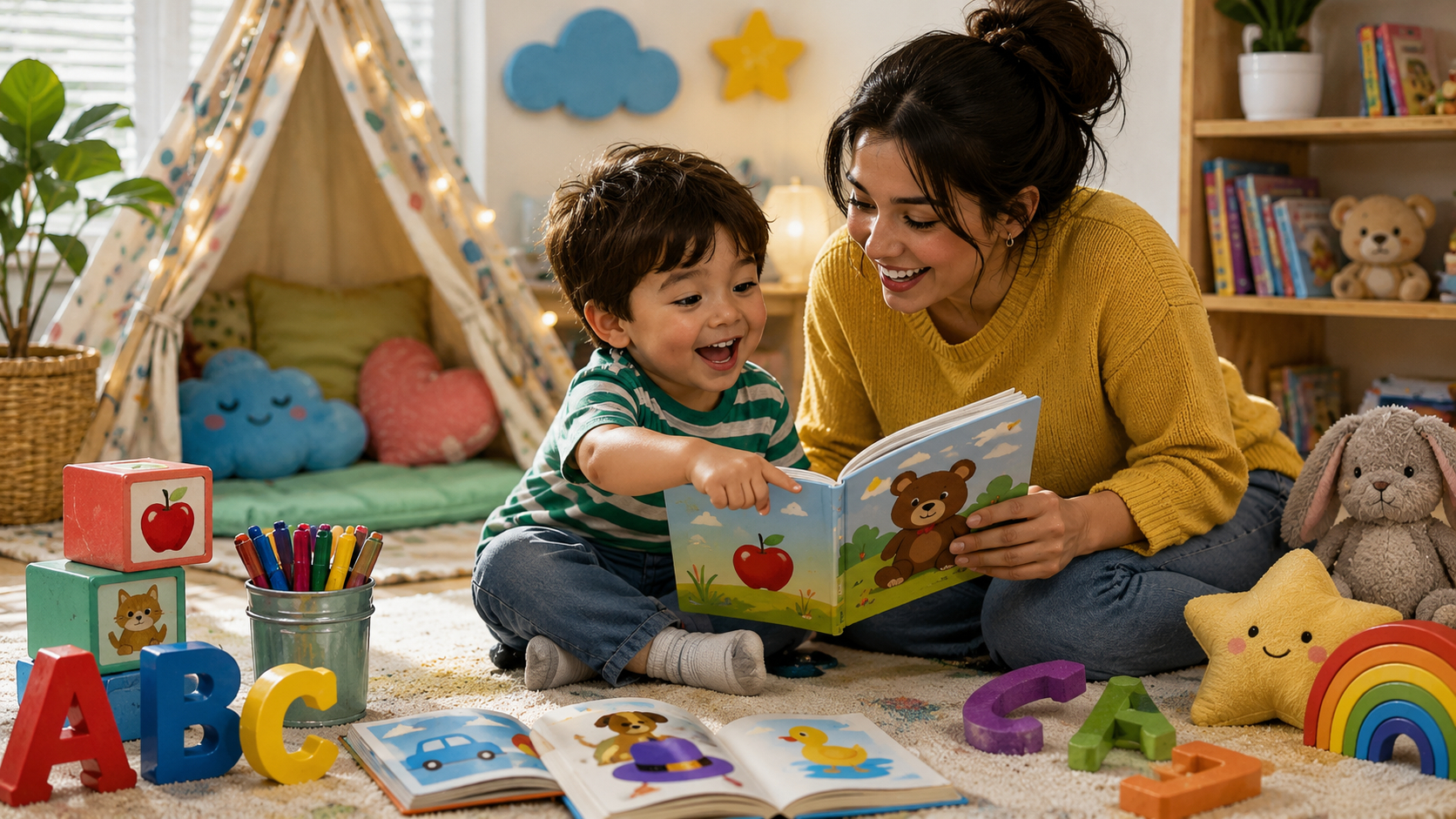
Your three-year-old picks up a familiar book, turns to a favorite page, and begins “reading” the story from memory.
A few minutes later, your child points to a word and asks, “What does this say?”
It is natural to wonder whether these moments mean your child is ready to read. You may also wonder whether you should begin teaching letters, sounding out words, or using a reading app.
The years between ages two and four are an important time for early literacy development, but most children do not need formal reading lessons yet. Instead, they need playful experiences that build the skills reading will eventually require.
Learning how to prepare your child for reading does not mean turning your home into a classroom. It means helping your child notice sounds, understand language, enjoy books, recognize patterns, and become curious about print.
These early skills create a strong foundation for later reading instruction. They also help children approach books with confidence rather than pressure.
Below are seven important early reading skills you can begin building between ages two and four, along with practical ways to support each one at home.
Impact-Site-Verification: 03562957-7bac-45d3-b040-0b93c95e2c51
What Does “Ready to Read” Really Mean?
Reading readiness is not one single milestone.
A child does not suddenly become ready because they know the alphabet, can write their name, or can recite a favorite book. Reading develops from several connected abilities that grow over time.
Before children can read independently, they gradually learn to:
-
Listen to and understand spoken language
-
Notice that words are made of sounds
-
Recognize that print carries meaning
-
Remember sequences and patterns
-
Follow a story from beginning to end
-
Connect letters with sounds
-
Feel comfortable trying something difficult
These abilities are sometimes called pre-reading or emergent literacy skills.
They develop through conversation, songs, play, read-alouds, rhymes, storytelling, and simple exposure to letters and words.
Some children become interested in letters very early. Others are more interested in stories, pictures, movement, or conversation. Both paths can lead to successful reading.
The goal between ages two and four is not to make your child read ahead of schedule. The goal is to give your child the language, sound awareness, attention, and confidence that will make reading instruction easier later.
Why Early Reading Skills Matter
Reading requires the brain to coordinate many tasks at once.
A beginning reader may need to:
-
Look at a letter
-
Remember its sound
-
Hold that sound in memory
-
Move to the next letter
-
Blend the sounds together
-
Recognize the word
-
Understand what the word means
-
Keep track of the sentence
That is a lot of work for a young child.
Early literacy activities help strengthen individual parts of this process before children are expected to combine them.
For example, singing rhyming songs helps children notice sound patterns. Talking about pictures strengthens vocabulary. Retelling a story strengthens memory and sequencing. Pointing to words while reading helps children understand how print works.
These activities may look simple, but they prepare the brain for more advanced reading tasks.
Skill 1: Listening and Understanding Language
The first step in learning how to prepare your child for reading is building strong oral language.
Children need to understand spoken words before they can understand written ones.
A child with a growing vocabulary has an advantage when beginning to read. When that child sounds out a word such as “rabbit,” the word already has meaning. The child can connect the printed word to something familiar.
Children build language through everyday interaction.
You do not need special lessons. Talking with your child during ordinary routines can make a significant difference.
For example, while making breakfast, you might say:
“The banana is soft inside, but the peel feels smooth.”
While walking outside, you might ask:
“Do you hear that bird? Does its song sound high or low?”
While cleaning up toys, you might say:
“Let’s put the blocks beside the basket and the cars inside it.”
These conversations expose children to descriptive words, location words, action words, and sentence patterns.
Simple ways to build language
-
Name objects your child notices
-
Describe what you are doing
-
Ask questions that require more than yes or no
-
Introduce one or two new words during a familiar activity
-
Give your child time to answer
-
Expand on what your child says
If your child says, “Big truck,” you might respond:
“Yes, that is an enormous dump truck. It is carrying a heavy load of dirt.”
You are not correcting your child. You are adding language to an idea your child already understands.
What progress may look like
Between ages two and four, children often begin using longer sentences, asking more questions, following more detailed directions, and explaining what happened during the day.
Development varies, so look for gradual growth rather than a specific vocabulary number.
Skill 2: Enjoying Books and Stories
Children are more likely to become willing readers when books feel familiar, enjoyable, and emotionally safe.
A two- or three-year-old does not need to sit quietly through a long story. Short, positive experiences are enough.
Your child may want to:
-
Turn pages quickly
-
Skip sections
-
Return to the same page repeatedly
-
Talk about the pictures instead of listening to the words
-
Hear the same book every night
-
Act out part of the story
-
Stop reading before the book ends
These behaviors are normal.
At this age, shared reading should feel more like connection than instruction.
How to make read-aloud time easier
Choose books with:
-
Clear pictures
-
Repetition
-
Rhythm or rhyme
-
Predictable language
-
Topics your child already enjoys
-
Short amounts of text
Let your child choose between two books. This gives your child some control without making the decision overwhelming.
You can also shorten the story by paraphrasing some pages. The goal is not to finish every word. The goal is to help your child associate books with comfort, curiosity, and shared attention.
Use simple questions
Instead of asking many quiz-like questions, make observations and invite conversation.
You might say:
“That dog looks surprised.”
“I wonder where the girl is going.”
“What do you think is inside the box?”
“Can you find the smallest animal?”
These comments help children look closely, think about meaning, and participate in the story.
Skill 3: Hearing Rhymes and Sound Patterns
Before children learn to connect letters with sounds, they benefit from noticing sounds in spoken language.
This ability is called phonological awareness.
For young children, it begins with broad and playful sound patterns such as:
-
Rhymes
-
Syllables
-
Repeated beginning sounds
-
Long and short words
-
Silly sound substitutions
A child does not need to explain what a rhyme is. Simply recognizing that “cat” and “hat” sound similar is an important early step.
Rhyming activities for ages two to four
Sing nursery rhymes and familiar songs.
Pause before the rhyming word:
“Twinkle, twinkle, little star,
How I wonder what you…”
Let your child fill in “are.”
You can also make silly rhymes:
“Bear, chair, hair, and…zair!”
Made-up words are acceptable. The goal is to hear the pattern.
Try a simple rhyme game:
“What rhymes with log? Dog or sun?”
Young children may guess at first. That is fine. Keep the activity light.
Clap syllables
Say a name slowly and clap the parts:
“Em-i-ly.”
“Di-no-saur.”
“Ba-na-na.”
Syllable play helps children understand that spoken words can be broken into smaller parts.
Notice beginning sounds
You might say:
“Mom and moon both start with the /m/ sound.”
“Sam, sock, and sandwich all start the same way.”
At this age, focus on hearing the sound rather than memorizing formal terminology.
Skill 4: Recognizing Letters Without Pressure
Letter recognition is an important early reading skill, but it does not need to be taught through drilling or constant testing.
Children learn letters more easily when the letters are connected to something meaningful.
A child’s own name is often the best place to begin.
You might say:
“Your name starts with M. M says /m/.”
Then point out the same letter on a cereal box, sign, puzzle, or book cover.
Start with meaningful letters
Useful early letters may include:
-
The first letter of your child’s name
-
Letters in family members’ names
-
Letters your child frequently sees
-
Letters connected to favorite animals, foods, or toys
A child who loves dinosaurs may be especially interested in D. A child who loves trains may remember T.
Use more than one format
Children need time to understand that an uppercase A and a lowercase a represent the same letter.
You can expose your child to letters through:
-
Alphabet books
-
Magnetic letters
-
Foam bath letters
-
Wooden puzzles
-
Sidewalk chalk
-
Labels
-
Simple letter-matching games
-
Age-appropriate literacy apps
Avoid expecting your child to learn all uppercase and lowercase letters at once.
A few familiar letters, learned gradually, are a strong beginning.
Should children learn letter names or sounds first?
Both are helpful.
Letter names make it easier to talk about letters. Letter sounds help children understand how letters work in words.
You might introduce both naturally:
“This is B. B can say /b/, like ball.”
There is no need to teach every possible sound a letter can make at this stage. Begin with the most common sound.
Skill 5: Understanding How Books and Print Work
Adults automatically know how to use a book, but young children must learn these habits through experience.
They gradually discover that:
-
A book has a front and back
-
Pages turn in a particular direction
-
English print moves from left to right
-
Words are different from pictures
-
Spaces separate words
-
Printed words stay the same each time
-
Letters combine to form words
These ideas are sometimes called concepts of print.
How to teach print awareness naturally
Occasionally point to the title on the cover.
Say:
“This is the title. It tells us the name of the book.”
Run your finger under a short sentence as you read it.
Point to a repeated word and say:
“This word says ‘go.’ We see it again on this page.”
Notice environmental print:
“That sign says STOP.”
“This label says MILK.”
“Your name is written on your cup.”
Do not point to every word during every read-aloud. Too much pointing can interrupt the story. Use it occasionally so your child begins to notice that the printed words are carrying the message.
Skill 6: Remembering and Retelling
Reading comprehension depends partly on memory.
Children need to remember what happened at the beginning of a sentence, paragraph, or story while continuing to process new information.
You can support this skill before formal reading begins through retelling and sequencing activities.
Ask your child to tell what happened
After reading a familiar book, ask:
“What happened first?”
“What did the bear do next?”
“How did the story end?”
Young children may not retell events in perfect order. They may mention only the most exciting part.
You can gently model a sequence:
“First the rabbit lost his hat. Then he asked his friends for help. At the end, he found it under the bench.”
Use everyday routines
Sequencing can also be practiced during the day.
“First we put on socks. Next we put on shoes. Then we go outside.”
“First we mixed the batter. Then we poured it into the pan. What happened after that?”
These simple conversations help children organize events and understand order.
Use pictures or objects
Place three pictures in front of your child and ask what happened first, next, and last.
You can also use toys to act out a short sequence:
“The car drove up the hill. It stopped at the store. Then it went home.”
Ask your child to repeat the sequence or create a new one.
Skill 7: Building Attention, Confidence, and Persistence
Reading readiness is not only about letters and sounds.
Children also need to practice staying with a task, trying again, and recovering when something feels difficult.
A young child’s attention span is naturally short. That does not mean your child is not ready to learn.
Instead of expecting long lessons, create short opportunities for focused participation.
A two-year-old may engage with a book for only a few minutes. A four-year-old may stay with a story or game longer, especially when the topic is interesting.
Keep activities short
Most early literacy activities can last five to ten minutes.
Stop while your child is still successful.
It is better to end with your child wanting one more turn than to continue until the activity becomes frustrating.
Praise effort specifically
Instead of saying only, “Good job,” try:
“You listened carefully to those sounds.”
“You remembered what happened next.”
“You kept trying even when that letter was hard to find.”
“You noticed that those two words rhyme.”
Specific praise shows children what they did successfully.
Avoid turning every activity into a test
Frequent questions such as “What letter is this?” can make reading activities feel like performance.
Balance questions with modeling.
Instead of testing, say:
“I see the letter S. It makes the /s/ sound.”
Then invite your child to find another S.
Children often learn more comfortably when they are allowed to observe before they are expected to answer.
What Early Reading Practice Can Look Like in Real Life
Parents sometimes assume that preparing a child to read requires a complete preschool curriculum.
It does not.
A simple routine may include just a few minutes of literacy throughout the day.
A sample 10-minute routine
Minutes 1–3: Sound play
Sing a rhyming song, clap syllables, or name words that begin with the same sound.
Minutes 4–8: Shared reading
Read a short picture book or a few pages of a longer one. Talk about one or two pictures.
Minutes 9–10: Letter connection
Notice one letter from the story, especially one connected to your child’s name or interests.
This routine can happen after breakfast, before quiet time, after dinner, or before bed.
Consistency matters more than choosing the perfect time.
How Literacy Apps Can Help Young Children
Literacy apps can support early reading skills when they are used thoughtfully.
For children between ages two and four, an app should not replace conversation, play, physical books, or shared reading. It can serve as one additional practice tool.
Helpful early literacy apps may provide:
-
Alphabet exposure
-
Letter-sound practice
-
Rhyming activities
-
Listening games
-
Vocabulary development
-
Story narration
-
Guided repetition
-
Immediate feedback
-
Progress tracking for parents
Some children respond well to visual movement, songs, or game-like repetition. These features can make practice feel approachable.
Choose apps that teach, not just entertain
Look for programs that clearly explain which skills they support.
A strong early literacy app should do more than ask children to tap colorful objects. The activity should connect to a real reading skill such as hearing a sound, matching a letter, identifying a rhyme, or following a story.
Use apps in short sessions
For young children, five to ten minutes may be enough.
You can sit beside your child during the first few sessions and describe what is happening:
“You found the letter that makes the /m/ sound.”
“Those two words rhyme.”
“The narrator is reading from left to right.”
Once your child understands the activity, some practice may become more independent.
Types of Early Reading Programs Parents May Explore
Different programs emphasize different parts of reading readiness.
Phonics-first programs
These programs introduce letters and sounds in a structured order. They may be most useful for children who are already showing interest in how words work.
Early literacy apps
These often combine songs, stories, letter games, vocabulary, and sound activities. They can provide broad exposure for younger children.
Read-aloud libraries
Digital libraries with narration can expose children to more stories and vocabulary. Whenever possible, combine listening with conversation about the story.
Speech and language activities
Some programs focus more heavily on listening, vocabulary, following directions, and expressive language. These skills support later reading comprehension.
Spelling and sound-matching tools
These are usually more appropriate as children get closer to kindergarten, but simple sound-matching activities may be useful for older preschoolers.
The best program is not necessarily the one with the most activities. It is the one that fits your child’s current interest, attention level, and learning needs.
What to Expect Realistically
Early literacy progress is rarely a straight line.
Your child may recognize a letter one day and forget it the next. A rhyme that seems obvious this week may be confusing next week.
This does not mean the activity failed.
Young children need repeated exposure in different settings.
You may notice progress in small ways:
-
Your child begins finishing a familiar rhyme
-
Your child asks what a sign says
-
Your child recognizes the first letter of their name
-
Your child retells part of a story
-
Your child pretends to read to a stuffed animal
-
Your child notices that two words sound alike
-
Your child chooses books without being prompted
These are meaningful signs of reading development.
Avoid comparing your child with siblings, classmates, or children shown online. Development between ages two and four varies widely.
Practical Tips That Make a Difference
Follow your child’s interests
A child who loves construction equipment may engage more with books about bulldozers than with a traditional alphabet book.
Interest supports attention.
Repeat favorite books
Repetition helps children learn vocabulary, sentence patterns, story structure, and prediction.
You may feel tired of a book long before your child has finished learning from it.
Keep books easy to reach
Place a small basket of books in the living room, bedroom, or play area.
Children are more likely to explore books when they can access them independently.
Combine movement with literacy
Ask your child to jump when hearing a rhyming word, clap syllables, form letters with play dough, or hunt for letters around the room.
Stop before frustration grows
A short successful activity is more valuable than a longer struggle.
Use multiple forms of practice
A child may learn the letter M through a book, magnetic letter, app activity, name card, and sidewalk chalk drawing.
Each experience strengthens the connection.
Do not rush into advanced reading
Some children begin reading simple words before age five, but early reading is not required for later success.
A strong foundation in language, sound awareness, comprehension, and confidence is more important than racing ahead.
Frequently Asked Questions
Should my two-year-old know the alphabet?
No. A two-year-old may enjoy alphabet songs or recognize a few letters, but there is no need to expect complete letter mastery.
Focus on conversation, songs, stories, and playful exposure.
Is memorizing a book the same as reading?
Not exactly, but memorizing a favorite book is still valuable.
It shows that your child is paying attention to language, sequence, rhythm, and meaning. Pretend reading also helps children practice how books work.
Should I correct my child when a word is wrong?
If your child is pretending to read or retelling a story, avoid correcting every mistake.
You can model the correct language naturally:
Child: “The dog goed home.”
Parent: “Yes, the dog went home.”
The same gentle approach works during early letter and sound activities.
Will apps prepare my child to read?
Apps can support early reading skills, but they work best as part of a larger routine that includes conversation, play, physical books, songs, and shared reading.
An app is a tool, not a complete reading environment.
How long should early literacy practice last?
For most children between ages two and four, short sessions are best.
Five to ten focused minutes can be enough. Shared reading may last longer when your child is interested.
Should I use more than one reading app?
Usually, one well-chosen program is enough at first.
Using several apps can make it difficult to tell which one is helping. Begin with one, use it consistently for several weeks, and observe how your child responds.
What should I try first?
Begin with the simplest options:
-
Read together every day.
-
Talk about what you see and do.
-
Sing rhyming songs.
-
Notice the letters in your child’s name.
-
Keep activities short and positive.
You can add an app or structured program if your child enjoys digital practice or if you want more guidance.
When to Seek Additional Support
Children develop at different rates, and not every delay indicates a serious problem.
However, consider speaking with your child’s pediatrician, preschool teacher, or a speech-language professional if you have ongoing concerns about your child’s ability to:
-
Understand simple directions
-
Hear or distinguish sounds
-
Use spoken language
-
Participate in conversation
-
Remember familiar words
-
Respond consistently to voices or sounds
-
Engage with books or stories at any level
Early support can be helpful, especially when hearing, speech, or language concerns are present.
Asking for guidance does not mean you have failed or that your child will struggle permanently. It simply gives you more information about what your child may need.
Related Tools Parents Often Explore Next
As your child approaches preschool or kindergarten, you may want to explore:
-
Alphabet and letter-sound programs
-
Early phonics apps
-
Rhyming and listening games
-
Digital read-aloud libraries
-
Vocabulary-building activities
-
Preschool reading-readiness programs
-
Handwriting and fine-motor tools
-
Comparisons of early literacy apps
-
Programs designed for children who need more repetition
Choose tools based on the skill your child is currently building rather than the number of features a program offers.
Final Thoughts
Learning how to prepare your child for reading is not about beginning formal instruction as early as possible.
It is about building the abilities that make reading possible.
Between ages two and four, your child can develop important skills by:
-
Listening to and using language
-
Enjoying books and stories
-
Hearing rhymes and sound patterns
-
Recognizing meaningful letters
-
Understanding how print works
-
Remembering and retelling events
-
Building attention, confidence, and persistence
These skills grow through small moments.
A song in the car, a bedtime story, a conversation during lunch, or a five-minute letter game can all contribute to reading readiness.
You do not need to do everything at once. Choose one simple activity, repeat it consistently, and follow your child’s interest.
Reading development is gradual. Small, positive experiences create the strongest beginning.